
9th July 2026
Has the world really changed?
AI has quickly become part of almost every leadership conversation. But does it fundamentally change what it takes to build a successful business?
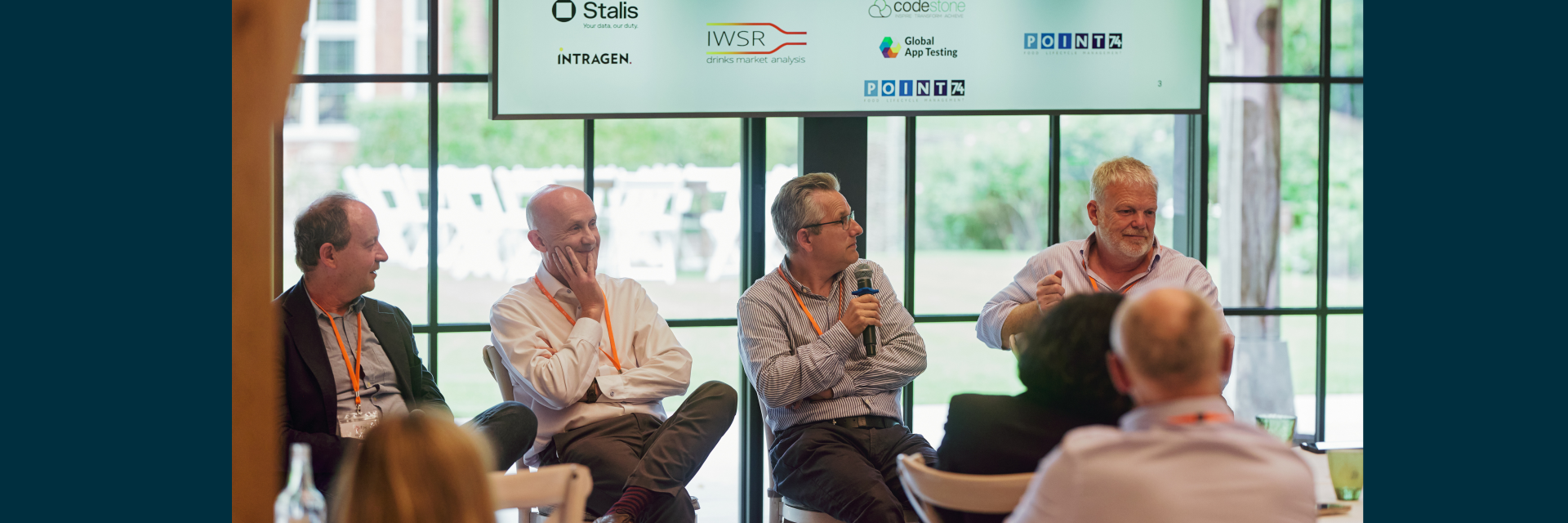
At this year's FPE Growth Conference, FPE Partner Chris Kay was joined by FPE's Senior Advisers Paul White, Mark Meek, Nik Bratton and Daniel Richardson to discuss exactly that question.
Collectively, they bring decades of experience building, scaling and leading software, data and software services businesses. Working alongside FPE and our portfolio companies, they support leadership teams through growth, operational change and value creation.
One of the strongest themes from the discussion was that while AI is changing the way businesses operate, the fundamentals of building great businesses remain remarkably consistent.
Building stronger businesses
Chris described FPE's approach to value creation as having two phases.
The first is building the foundations of a business. That starts with people. As businesses grow, leadership teams often need additional expertise and capability to support the next stage of their journey. Over the course of an investment, that may include broadening executive teams, appointing experienced chairs and non-executives, or bringing in specialists across areas such as finance, technology, product and go-to-market, with prior expertise in delivering an accelerated stage of growth.
Alongside people come processes and infrastructure needed to support growth. Systems, reporting, operating processes and ways of working all need to evolve as organisations scale. While these changes are not always the most visible, they are often what enable businesses to continue growing successfully without becoming constrained by their own success.
With those foundations in place, attention can turn to acceleration: expanding into new markets, investing in growth and helping businesses realise their ambitions.
The objective is not simply growth. It is to build businesses that are stronger, more scalable and more valuable.
What we're seeing change
Daniel discussed how AI is changing the role of engineering teams. As AI takes on more routine development tasks, engineers are able to focus on more complex problems and higher-value work. The businesses seeing the greatest impact are those combining strong engineering talent with the effective use of AI tools.
For data businesses, the conversation centred on differentiation. Mark highlighted the importance of proprietary data, specialist expertise and customer intimacy. While AI can make information easier to access and analyse, sustainable advantage still comes from differentiated data, embedded in customers’ workflows, and delivering insight in ways customers genuinely value.
The discussion also explored the implications for services businesses. Paul highlighted how AI-driven productivity improvements raise questions about how businesses capture value. As AI changes how work is delivered, many organisations are reassessing how they package, commercialise and monetise their expertise.
Across each of these areas, the message was consistent: AI can create new opportunities, but it is how businesses evolve their proposition and operating model to capture value that matters most.
The evolving role of the CFO
Nik shared his experience of working closely with growing businesses and finance teams. While financial rigour remains essential, he argued that the role of the CFO increasingly extends beyond reporting and control. Increasingly, the role is to help businesses make better decisions, bringing together information from across the organisation and enabling growth. This layer of control and rigour becomes even more important as businesses invest in AI, where usage costs can increase quickly, often without a clear or attributable return on investment.
As technology continues to evolve, leadership teams are faced with more information, more opportunities and more choices than ever before. The challenge is not simply adopting new tools. It is making good decisions about where to invest, how to prioritise resources and how to build organisations that can continue to scale.
So, has the world really changed?
The answer is both yes and no.
AI is clearly influencing how products are developed, how services are delivered and how businesses operate. New technologies are creating opportunities to improve productivity, accelerate innovation and unlock greater value from data.
But these changes do not remove the need for strong leadership, clear strategy and disciplined execution.
If anything, they make those qualities more important.
The businesses that succeed will not simply be those that adopt AI. They will be those who use it to strengthen their teams, deepen their expertise, serve customers more effectively and build more resilient organisations.