

14th September 2026
What is currently driving software valuations?
Ben Cole, Partner at FPE, analyses 27 publicly listed business application software companies to explore how durability and growth are influencing valuations - and what the data tells us about how the market is defining software quality today.
Seven months have elapsed since the SaaSpocalypse. It was a time for doom mongering and engagement bait, with a wide variety of SaaS negativity permeating LinkedIn and the press. Our view at the time was that the sell off was too broad and, in certain areas, too deep, and that share prices would start to be treated on their individual merits as investors formed a more discriminating view on quality. But what is meant by “quality”? And is this what has happened?
To answer the question, we’ve been looking at 27 business application software providers trading on public markets. We’ve focused on business applications mainly because they are our core investment focus at FPE, and have left out software companies in areas like cybersecurity, IT infrastructure, and hardware as a result. Here’s the list, which we will come back to later (data as of 3rd Sept):
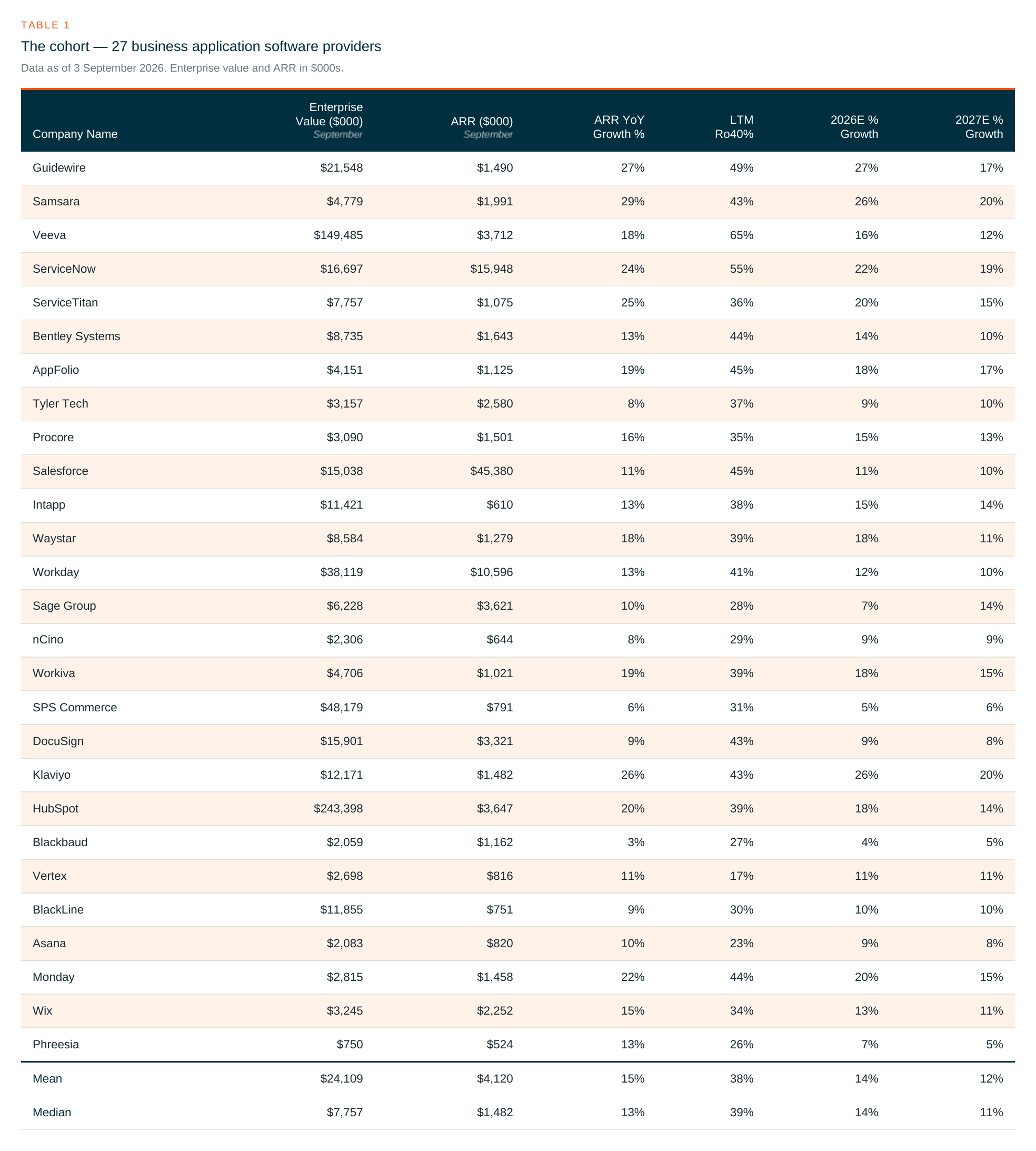
In February, public investors sold these businesses as a homogenous category, partly due to post-Covid declining growth rates (see Jason Lemkin), but catalysed by the release of agentic tools that threatened software’s moats and business model. Uncertainty reigned, risk premiums increased, terminal values contracted, and stock prices were torched across the board. At the bottom, names like Salesforce, ServiceNow and Workday had fallen to around 60% of their January prices, and close to $300bn of value had been wiped out across markets.
And then people started thinking. Why, really, is a software business valuable?
Those of us that spend our lives around software companies, either as builders or investors, felt that the sell-off was overblown. In the immediate aftermath, the first line of defence, repeated in meetings and on podcasts, went along the lines of “software has never been about the code, it’s about solving a business problem”. It’s hard to argue otherwise, but it’s also lightweight. There are obvious follow-up questions:
- Now that everyone has access to LLMs, to what extent is this software company solving a difficult problem, and could it be solved in another way?
- Now that it has access to LLMs, what additional problems could this software company solve?
Or:
- Is the core business durable?
- Is the business well-positioned for future growth?
Since February, a huge amount of brain power (and maybe some compute) has been absorbed by these questions. What, in this new world where the cost of writing code is tending towards zero, gives a software business durability? And why, with threats of increased competition from existing and new market participants, as well as internal vibe-coders, does a software business have a right to grow and capture future value including that which is being created by AI?
Going back to our list of companies, we wanted to analyse how perceptions around durability and growth have driven share prices and valuations since the SaaSpocalypse. But how to capture each? Growth can be found in the forecasts of publicly listed software businesses. It’s an imperfect measure – it’s a forecast after all – but it will do for now. We use consensus 2027E revenue growth and scored companies growing at more than 11% (the cohort’s median growth rate) as “high” growth, and equal to or less than 11% as “low” growth.
What makes a software business durable? Plenty of smart people have provided their view – work from Devin Mathews, Gokul Rajaram, and Simon-Kucher Partners are all good examples (and there are many more). Simply put, at FPE we believe that durability is measured by the extent to which software is:
- Consequential - Is the software a system of record? Does its output take precedence over other systems in a dispute? How important is the data? What are the consequences if the data is wrong or unavailable?
- Coordinating – how many people, across how many departments, depend on the software to do their jobs? How often are they using it? How complex are the workflows? Can the workflows be carried out without it?
- Codified – is organisational compliance, security, and audit embedded within the software? Is the software named in written procedures, or critical to what a regulator or auditor expects to see?
- Compounding – does the value of the software increase over time through data accumulation from multiple sources, network effects, or domain insight and ultimately, deliver better outcomes for the user?
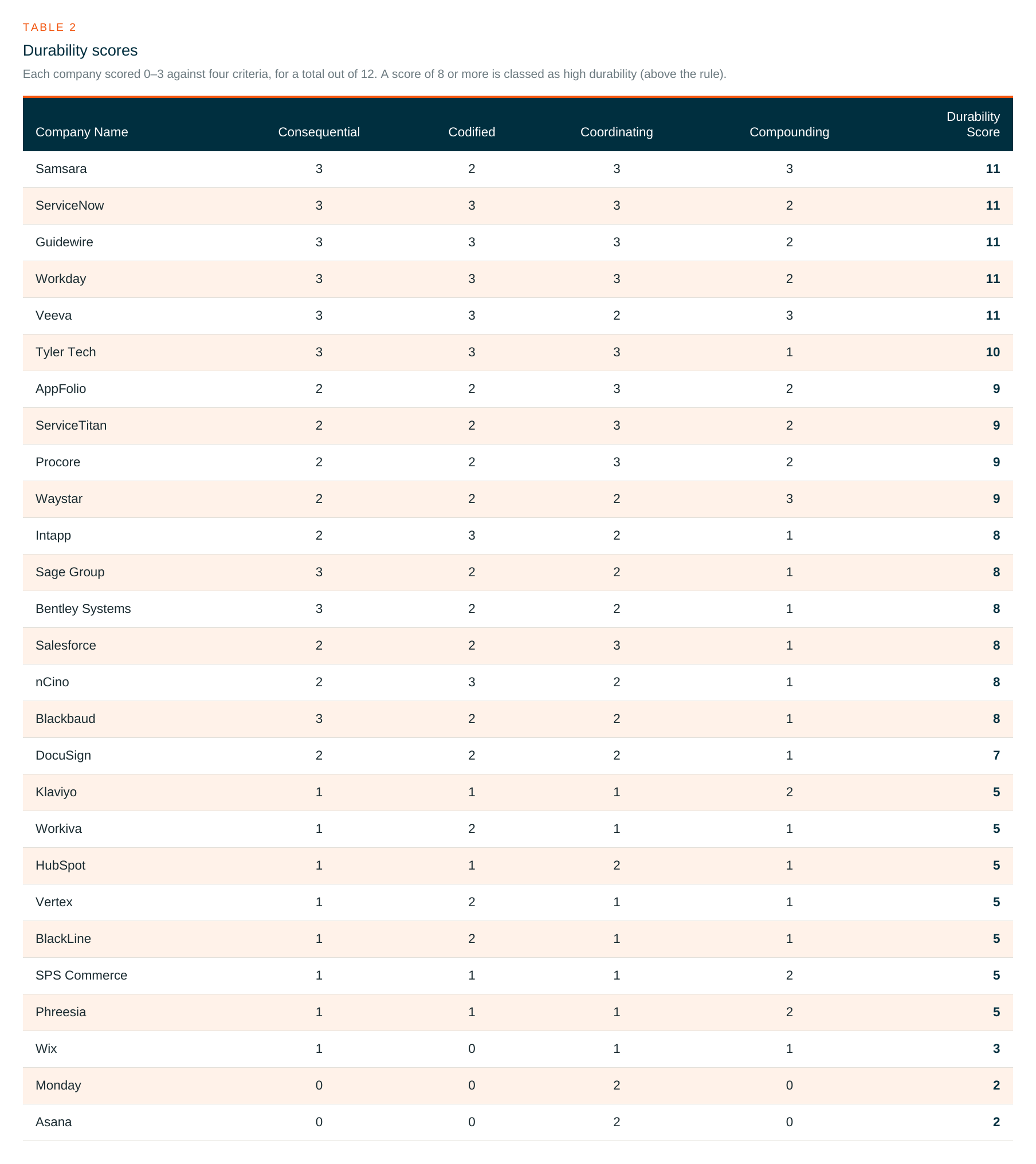
We scored each of the 27 companies based on their business characteristics against each of our durability criteria - 3 for strong fit down to zero for no fit - and gave each a total “durability score” out of 12. We classed companies with a durability score of eight or more as “high” durability, and the others as “low”. It’s another imperfect data point, and we are fully aware of its limitations (if you know these companies better than we do, and you disagree with our analysis, then please get in touch).
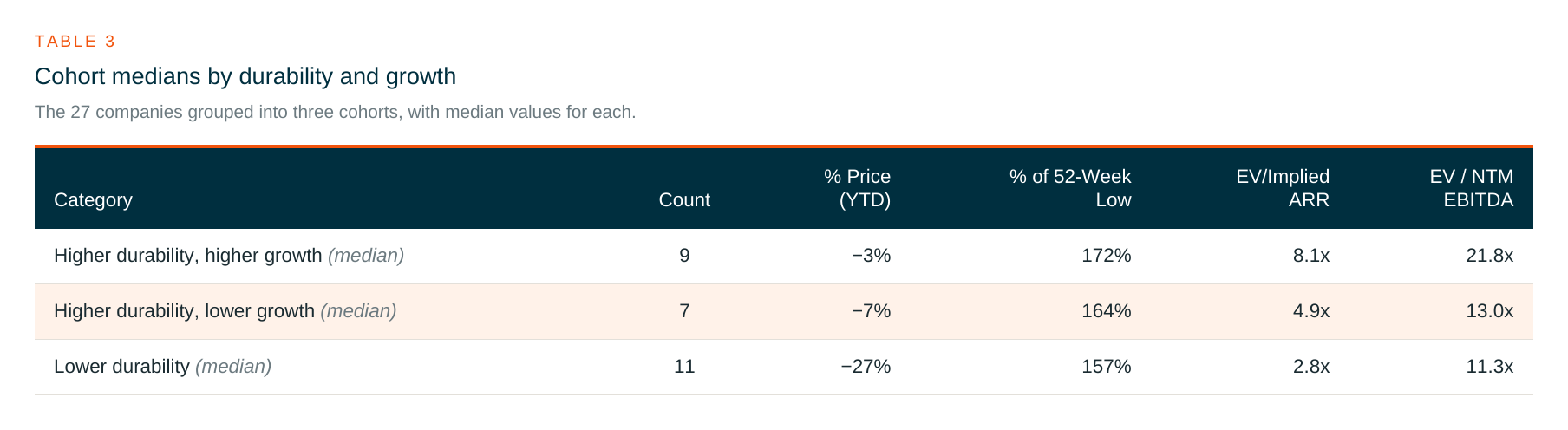
But when analysed against the growth criteria the results were interesting:
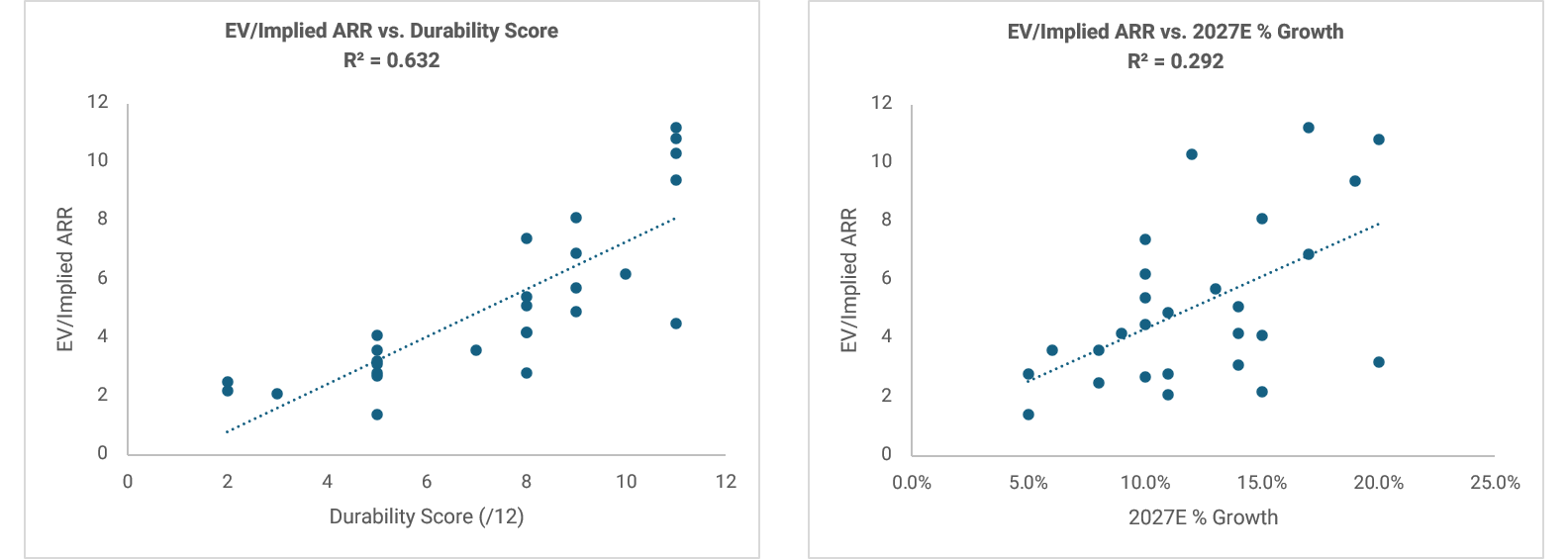
We then regressed ARR multiples separately against durability and growth:
Our analysis suggests that:
- At this point in the cycle, the market is paying more for durability than for headline growth. Durability explains 63% of the variance in ARR multiples, vs. 29% for forecast growth.
- There is a clear ARR multiple progression between the cohorts. Median EV/Implied ARR falls from 8.1x for “higher durability, higher growth” names (e.g. Samsara, Guidewire, and ServiceNow), to 4.9x for “higher durability, lower growth” (e.g. Procore, Workday, Salesforce), to 2.8x for lower durability companies (e.g. HubSpot, DocuSign, Klaviyo).
- Movements in share price line up with durability; the median “higher durability, higher growth” company is down just 3% year to date, whereas the median low durability company is down 27%. The bottom cohort has also recovered the least from its trough, trading at 157% of its 52 week low versus 172% for the top cohort. All this suggests that low durability companies have been de-rated the most aggressively.
- Durability and growth are largely unrelated in this sample, with a correlation of 0.28, which is not statistically significant at this sample size.
High durability names have re-emerged in a stronger position. “Quality”, as the market is currently pricing it, means durability first and growth second. Software that is consequential, coordinating, codified and compounding is hard to do without, regardless of how cheap in theory it becomes to rebuild.
But why are investors putting a premium on durability? We have a few thoughts. It could be because growth is a double-edged sword; revenue easily won is revenue easily gone. It could be because the SaaSpocalypse was a terminal value event, and that there is more conviction / less risk in the terminal value of more durable companies. Or it could be because cheap intelligence has made growth more abundant and characteristics of a durable software business scarcer. More likely a combination of all three.
There are some caveats that accompany our analysis:
- 27 companies is a relatively small sample size
- Seven months is a short window
- Both our growth and durability measures are imperfect
But the key findings fit our lived experience, which is that right now a higher premium is being placed on durability, and that growth and durability are independent of each other.
We’ll be keeping a close eye on reported retention over the coming 2-3 quarters - durability is a defensive measure, and if AI driven churn isn’t observed in the short to medium term, then the threat could become priced out and the market could start swinging back towards growth.
Is this a RenaisSaaSance? Not for every SaaS company, but for now quality, in the form of durability, is certainly being priced